Every management meeting in Dhaka this year has some version of the same slide: "We are adopting AI." Fewer meetings ask the harder question: adopting it how, and measured against what. Three global research efforts published in 2026, from McKinsey, BCG, and Deloitte, all converge on the same uncomfortable finding, and it applies directly to Bangladesh: buying tools and issuing logins is the easy 10% of the work. The other 90% is redesigning how the work actually gets done. Get the sequencing wrong, and a company can spend a year "on AI" and have nothing to show for it beyond a few enthusiastic individual users.
What the global data actually says
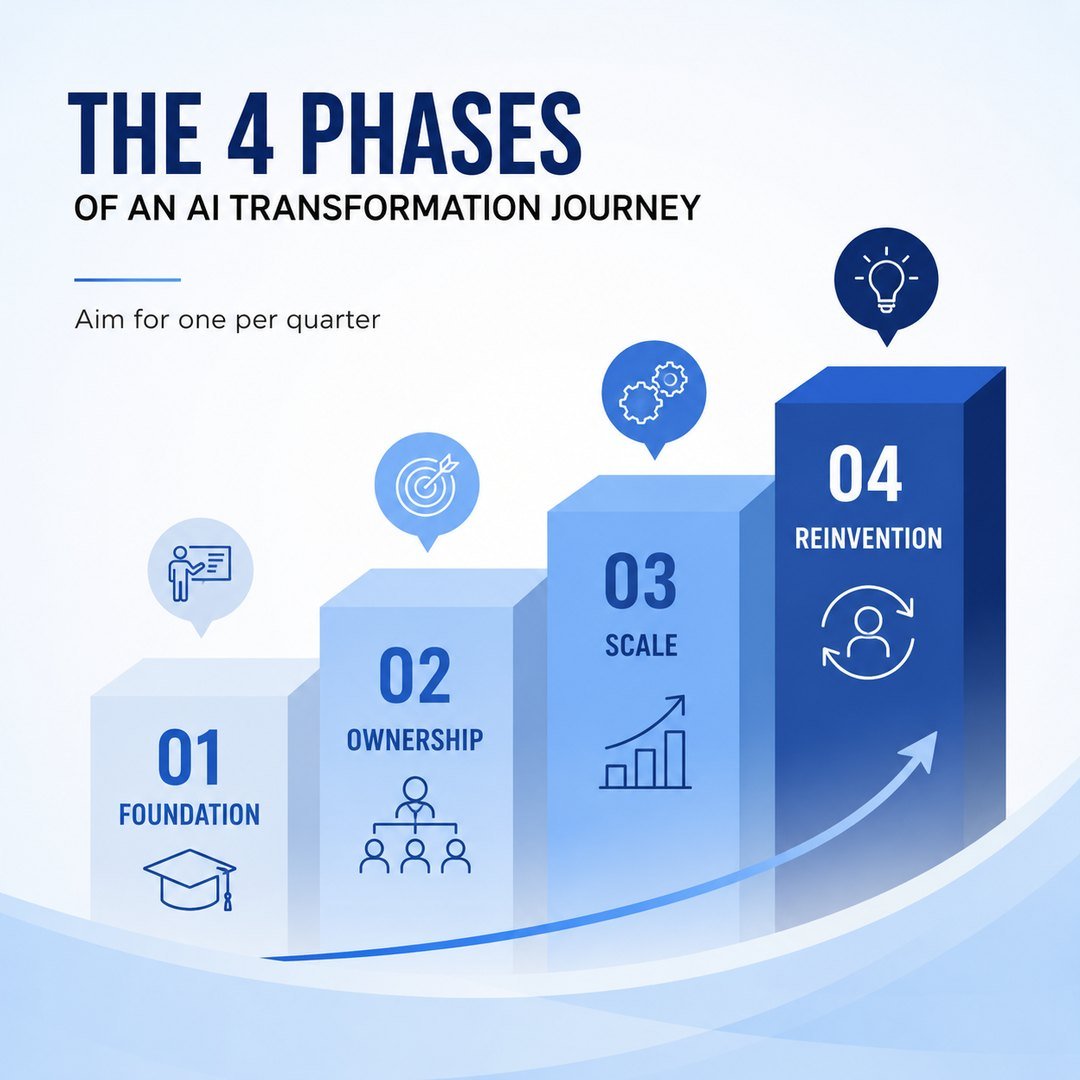
McKinsey's newest research, based on a global survey of roughly 750 leaders and employees, frames AI adoption as three horizons: enablement (giving staff general-purpose tools like a chatbot to speed up existing tasks), automation (redesigning cross-functional workflows so AI does structured work at scale), and reinvention (rebuilding roles and operating models around AI). The finding that should worry every management team: only about 1 in 10 organizations globally has reached reinvention. The bigger problem is a readiness gap, the large majority of employees say they personally feel ready to use AI, but only a minority of leaders believe their organization is ready to make the people and culture changes needed to capture value from it. In other words, the bottleneck isn't the technology or even the staff. It's leadership and organizational design.
BCG's 2026 survey of close to 12,000 employees globally tells a similar story from a different angle. Daily AI use among frontline staff has jumped sharply year over year, and a large share of regular users report meaningfully reclaiming hours every week. But most organizations haven't figured out how to convert those individual hours saved into company-level value, because time saved by one person on one task doesn't automatically become a redesigned process, a lower cost base, or a faster customer response. BCG's conclusion is blunt: strategic clarity, a small number of well-chosen priorities, explicit workflow redesign, real change management, matters more than which tool you buy.
Deloitte's "State of AI in the Enterprise" survey of over 3,000 senior leaders adds the financial angle. Two-thirds of organizations report real productivity and efficiency gains from AI already. Yet the large majority still have not redesigned jobs or workflows around what AI can now do, they've simply layered a tool on top of the old process. That gap between "using AI" and "having restructured work around AI" is exactly where most of the unrealized value is sitting.
Put together, all three reports are describing the same failure mode: companies buy the tool, skip the redesign, and wonder why the ROI didn't show up.
Why this matters more, not less, in Bangladesh
It would be easy to read the above and think "that's a problem for large multinational enterprises with complex tech stacks." The opposite is true for Bangladesh. Most Bangladeshi companies, including a large share of the country's MSMEs, which make up roughly a quarter of GDP and a similar share of the workforce, still run core operations on spreadsheets, WhatsApp, paper, and the tribal knowledge of one or two key staff. That is actually an advantage here: workflow redesign doesn't require tearing out a mature ERP system first. But it also means the temptation to stop at "enablement", handing out AI logins and calling it a transformation, is stronger, because there's no existing digital backbone forcing a deeper rebuild.
Bangladesh's own digital base is no longer a limiting factor. Internet penetration is now above 70%, which is more than enough to run cloud-based business tools, chat-based assistants, and lightweight automation across a company of any size. The constraint isn't access to technology. It's sequencing.
A rollout ladder that actually fits a Bangladeshi company
Translating the three-horizon research into something a BD business can execute in the next two quarters looks like this:
Horizon 1, Enablement (Weeks 1–4). Get management and 2–3 target departments genuinely fluent in a general-purpose AI tool for drafting, summarizing, and searching internal information. This is where most companies stop, and where most companies should only start. The point of this stage is not the tool; it's building enough hands-on comfort that people can accurately describe, in the next stage, which parts of their actual workflow are repetitive and painful.
Horizon 2, Automation (Weeks 4–12). This is where the real ROI lives, and where most Bangladeshi companies should concentrate their year-one budget. Pick one workflow, inquiry-to-lead handling, invoice and document processing, meeting/attendance/reporting automation, an internal knowledge assistant over SOPs and price lists, and rebuild it end-to-end with a human still reviewing the exceptions. This is deliberately narrow: one workflow, one department, one measurable before/after number, not a company-wide initiative.
Horizon 3, Reinvention (Year two and beyond). Only after a company has two or three automation wins under its belt, with real before/after numbers, not opinions, does it make sense to talk about restructuring roles or building an "AI-first" operating model at the executive layer. Reaching for this stage first is precisely the mistake the global data warns against: 11% of the world's most sophisticated companies have gotten there after years of investment. A BD company skipping straight to it in month one is skipping the evidence-gathering that makes reinvention safe and fundable.
The three mistakes to avoid
Confusing tool rollout with transformation. Issuing ChatGPT or Claude seats to 50 staff is enablement, not automation. It's a fine first step, but budget and executive attention shouldn't stop there.
Skipping the metric. Every pilot needs one number attached before it starts, hours saved per employee per month, turnaround time on a specific document, error rate on a specific report. Without it, "it feels faster" is not something a board or an investor can act on.
Ignoring governance early. Bangladesh now has a Personal Data Protection Ordinance and a National Data Governance Ordinance, alongside a draft National AI Policy that flags healthcare, employment, and other sensitive-decision contexts for extra scrutiny. Building basic data-handling and human-review discipline into the very first pilot is far cheaper than retrofitting it after five workflows are already live.
What "good" looks like in month three
A company that has rolled this out correctly by month three has: one completed automation pilot in a real department, one specific number showing the gain (time, cost, or error rate), one internal champion outside the founder/CEO who can explain the workflow to a colleague, and a short, honest list of what still needs a human. That's a modest-sounding outcome. It's also exactly the foundation the global research says most organizations, anywhere in the world, still don't have after a year of "adopting AI."
The companies that will look meaningfully different in Bangladesh two years from now won't be the ones with the most AI licenses. They'll be the ones that treated the first workflow redesign as seriously as McKinsey, BCG, and Deloitte's own data says it deserves to be treated.
Sources: McKinsey & Company, "From Adoption to Impact: Three Horizons of AI Transformation" (2026); BCG, "AI at Work: Why Strategy Matters More Than Tools" (2026); Deloitte AI Institute, "The State of AI in the Enterprise" (2026 edition).