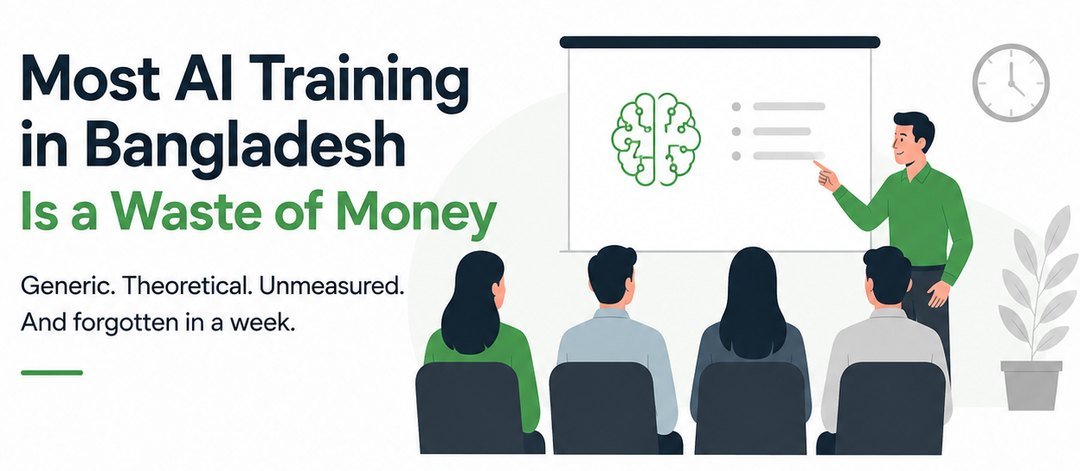
Companies across Bangladesh are booking AI workshops this year. Slides get shown, certificates get handed out, everyone claps, and three weeks later almost nobody is doing anything differently. The tools weren't the problem. The training was. Most AI training fails not because the content is wrong, but because it's generic, theory-heavy, and never measured. Here is what actually makes it worth the money.
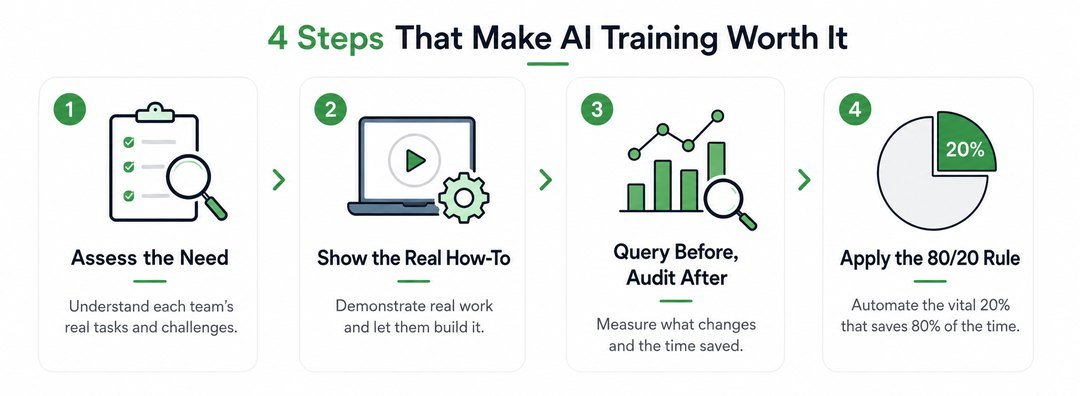
1. Assess the need before you train, not after
Most trainers arrive with one fixed deck and deliver the same session to a sales team, an accounts team and a factory floor. It's efficient for the trainer and useless for the room.
- Ask first, what does each team actually do all day, and where does the time go?
- Then shape the session, so the examples are their invoices, their customer replies, their reports, their Proposal, not generic prompts.
- The test, a participant should see their own daily task on the screen within the first ten minutes.
2. Show the real how-to, not just the theory
Explaining "what AI can do" inspires people for an afternoon. Showing them do their own task, live, changes how they work on Monday.
- Demonstrate real cases, take a genuine task from the room and automate it in front of them, start to finish.
- Let them build one thing, hands on keyboard, their own example, before they leave.
- Skip the hype, no history of AI, no jargon; tool time in action on screen beats time on slides.
3. Query before, audit after
This is the step almost every training skips, and it's the one that proves whether any money was well spent.
- Before, ask each participant to list their most repetitive weekly tasks. This becomes the training agenda and the baseline.
- After, audit a few weeks later: which of those tasks are they now doing with AI, and how much time did it save?
- Report it, hours saved and tasks changed are numbers management can act on. "Everyone enjoyed it" is not.
4. Apply the 80/20 rule, automate the vital 20%
You don't need to automate everything. Most of the value hides in a small handful of tasks that eat most of the time.
- Find the 20%, the few repetitive tasks that consume roughly 80% of a person's routine effort.
- Automate those first, follow-ups, report writing, data entry, replying to common queries.
- Ignore the rest for now, chasing every edge case is how training becomes overwhelming and gets abandoned.
What good training actually looks like
| Typical training | Better training |
|---|---|
| One generic deck for everyone | Session shaped around each team's real tasks |
| Theory and inspiration | Live demos of the participants' own work |
| Ends at the certificate | Follow-up audit of what people actually implemented |
| "Learn all of AI" | Automate the vital 20% that saves the most time |
Bottom line
AI training isn't a waste of money because AI doesn't work, it clearly does. It's a waste when it's generic, theoretical and unmeasured. Assess the need, demonstrate the real work, measure before and after, and automate the vital few tasks first. Do those four things and training stops being an expense line and starts being the cheapest productivity gain your company will make this year.