Most companies get AI automation wrong in the same way: they try to do everything at once. A grand "digital transformation" is announced, five departments are involved, and few months later there's a lot of activity and nothing much meaningful anyone can point to. The companies that actually win start the opposite way, deliberately small. One workflow. One department. One number to prove it worked. Get that first win, and everything after it becomes easier to fund, staff and expand.
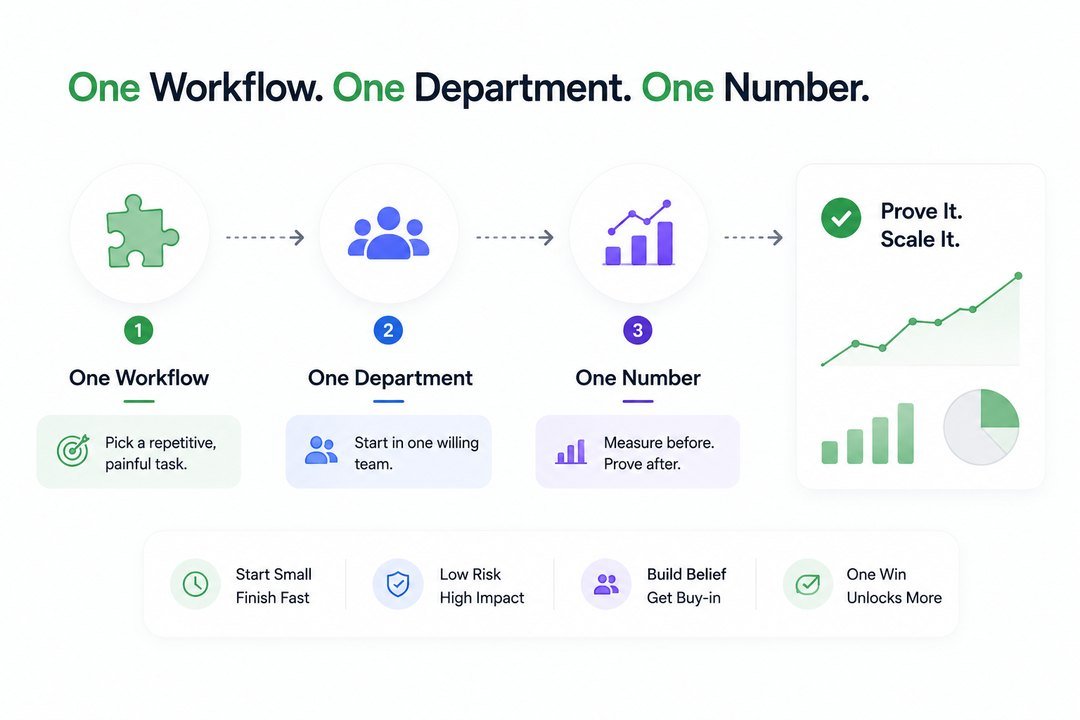
Why starting narrow beats going big
- It's finishable, one workflow in one team can be built and running in weeks, not quarters.
- It's provable, a single before/after number tells you honestly whether it worked, where to improve.
- It's safe, if something breaks, it breaks in one place, not across the whole company.
- It builds belief, one real win convinces the skeptics far better than any presentation.
Step 1, Pick one workflow
Choose a task that is repetitive, painful and done often. Avoid anything rare, creative or high-stakes for a first attempt. Good starting points:
- Sales, following up with leads who've gone quiet.
- Accounts, processing invoices or chasing receivables.
- Operations, turning meeting notes into task lists, or compiling a daily or weekly report.
- Customer service, drafting replies to the questions you answer again and again.
Step 2, Pick one department
Run it in a single team with a manager who actually wants it. Enthusiasm matters more than size. One willing department gives you a controlled space to learn, adjust and show results, without company-wide risk or politics slowing you down.
Step 3, Pick one number
This is the step most companies skip, and it's the one that makes or breaks the case. Before you start, agree on a single metric and measure it today, so you have a baseline to compare against.
| Workflow | The one number to track |
| Sales follow-up | Leads contacted per week / deals not lost to silence |
| Invoice processing | Hours spent per week, or days to process |
| Daily/weekly report | Time to produce the report |
| Customer replies | Average response time to a common query |
"It feels faster" is not a result. "We cut report time from 4 hours to 20 minutes" is, and that's the sentence that unlocks the budget for your next automation.
What a good first win looks like
- One workflow, rebuilt end to end, with a human still reviewing the exceptions.
- One department, using it as a normal part of their week, not a one-off experiment.
- One number, a clear before/after that leadership can see and trust.
- One champion, someone besides the owner who can explain it to the next team.
Bottom line
You don't need a transformation strategy to start. You need one repetitive workflow, one willing department, and one honest number. Prove it there, bank the result, and let that first win pay for the second. In Bangladesh, where most companies are still deciding whether to begin, the one that quietly ships a single working automation this quarter is already ahead of the ones still planning the perfect one.